


The Elite Address

Updated: Sep 11, 2025
The Lawyer's Block Building (1889)
Architect: McDougall and Sons
Architectural Style: Italian Renaissance
Many buildings gain recognition not only for their aesthetic appeal but
also for their illustrious tenants. None more so than the elegant
Lawyer’s Block, also known as “Attorney’s Headquarters.”
The lot was originally sold by Alonzo Horton to George Phillips
Marston of Wisconsin. Mr. Marston, an asthmatic, claimed he would
not spend another harsh winter in Wisconsin! On October 4, 1870, he
arrived in San Diego by steamer with his entire family - wife and three
children. One of those children, George White Marston, grew up to be
one of early San Diego’s most prominent businessmen, civic leaders
and founder of the Marston Department stores.
After George F. Marston’s death in 1877, the property was leased and
subleased several times. Pacific Livery Stables occupied the space
until 1886, and in 1887, 6 months before her death, Harriet Marston
sold the property to A.G. Gassen and Aaron and Charles Pauley. On
September 27, 1888, the San Diego Union prematurely broke the
story that the new owners planned to build a structure on the corner of
4th and E , which would cost $700,000! J.C. Sloan was hired as
contractor and the firm of McDougall and Sons, from San Francisco,
was appointed as architects.
The contractors said that the building would be completed by July
1,1889, and would-be tenants immediately signed up. Twenty spaces
on the second floor were rented by lawyers, which gave rise to the
notion that Gassen and Pauley intended to make their building the
unofficial headquarters for San Diego’s prominent lawyers. They
included Colonel Chalmers Scott, former State Attorney General,
Harry C. Titus, City Attorney, William J. Hunsaker, son of a former
sheriff and mayor, and prominent attorneys A.E. Cochran , Eugene
Britt, Cassius Carter and Judge J.M. Robinson. Seven to ten firms
were represented before the builders even broke ground! Hunsaker
and Britt also leased several rooms to house an extensive law library.
Other tenants included the Farmer’s and Mechanic’s Union, a
drugstore, a pharmacist, and six architects. The well known architects
were represented by D.P. Benson (New County Courthouse), A. Reif (
new Catholic Church & the Marshall Law block) and John B. Stannard
(Louis Bank of Commerce, Grand Pacific, Nash Block & the Cole
Block.)
Additionally, other tenants included a stock broker, three insurance
agents, The Golden Era Magazine, the Great Southwest Magazine,
and the business office for the San Diego Union. The Union housed its
presses in the basement and the linotype machines on the second
floor. Also - a liquor store, two barber shops and a paint store made
the Lawyer’s Block their home.
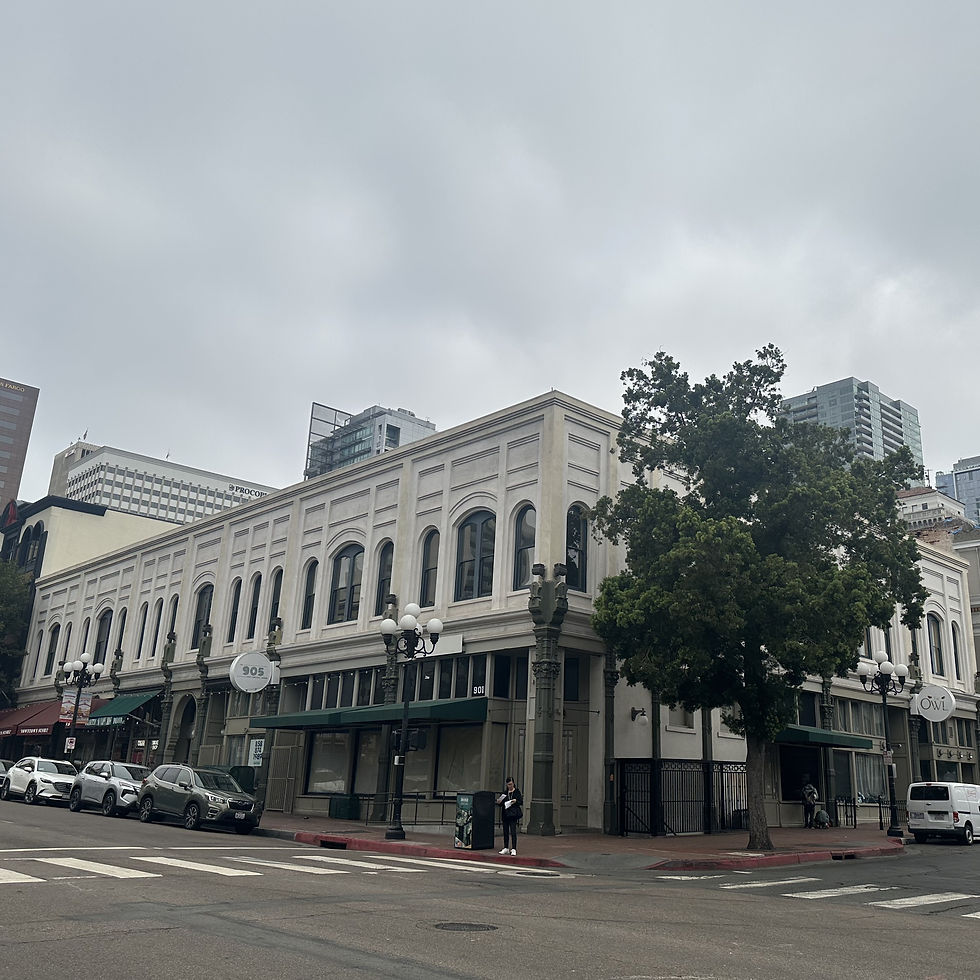
The Italian Renaissance rectangular building, which was completed on
schedule, was a two story, plus basement, structure built with bricks
made at the Rose Canyon brickyard. The composition was stucco
over brick with a flat roof. A horizontal band frieze runs along the edge
of the roof line. The facades on both sides were symmetrical with
evenly spaced doors and windows on each floor. The first floor had
regularly spaced openings for shop entrances with recessed
doorways. Large rectangular windows provided light and were
accented by multi-paned, narrow windows above the main window.
The windows on the second floor were single, double-hung sash style,
and shaped in the form of Roman arches. These were alternated with
narrow windows with less curved arches. Pilasters along the facade
were painted in darker tones to contrast with the lighter colored
stucco.
After Aaron Pauley’s death, the property changed hands on May 6,
1900. It was purchased for $115,000 by John H. Gay, who was listed
in the City Directory as a capitalist. Mr. Gay, son of a Louisiana state
senator, came to San Diego for his health, and upon his arrival,
immediately started buying property. Some of his properties included
the Dare Mansion, the Lakeside Inn and Racetrack and a ranch at
Linda Vista Mesa. His elaborate home on Fifth and Juniper was
known as “Bluebeard’s Castle.”
Throughout the years, several abstract and title companies moved in,
as well as many stenographers and Notary Publics. Almost all of the
stenographers and notaries were women, an indicator that more
diverse professional opportunities were becoming available to
females.
When John Gay died, his widow, Jeanette T. Gay , inherited the
property. His estate was valued at $650,000 in real estate and
$285,000 in personal assets. The Gay family - 18 to 20 persons -
contested the will on the grounds of his mental state. For 8 years prior
to his passing, he had been an alcoholic, paralyzed, and exhibiting an
impaired mental capacity. Seven years earlier, he had hired Jeanette
as a housekeeper and then married her. The family claimed she had
coerced, dominated and controlled him completely. They were
awarded large amounts of the estate, but Jeanette kept the Lawyer’s
Block property, which she sold to L. M. Carey, H. G. Jones, George F.
Boehing and L. M. Steinmetz in 1920.
The last upstairs tenants vacated the offices in 1972, and the income
for the property was then derived from the lower floor leases.
Currently, the property is available for lease.


Comments